
Municipal Separate Storm Sewer System (MS4) Permit
Any and all attachments to the permit can be found on the State of Michigan MiWaters webpage
This website uses cookies to enhance usability and provide you with a more personal experience. By using this website, you agree to our use of cookies as explained in our Privacy Policy.
The City will issue permits to industrial facilities that have the potential to impact stormwater quality. The potential impact will be determined through a survey process which could include an inspection of the facility.
If permitted by the City Industrial Stormwater Program (ISP), the facility will be issued a permit with a priority level. The priority level will determine length of the permit, frequency of inspections and fee associated with the permit.
A facility will be inspected at a minimum with every issued permit including the renewals. A Re-Inspection and associated fee may be required for reportable spills or concerns with permit regulations. A City permit will have to be renewed based on the assigned priority every 1 to 5 years.
The property owner of any proposed development, redevelopment or transfer of an industrial property in the City that involves the drainage of surface runoff shall complete an Industrial Stormwater Survey to determine if a City-issued industrial stormwater discharge permit is required for the site.
When exposed to the elements:

If the facility’s SIC/NAICS code is regulated and it has a point source discharge, the site has the potential to discharge pollutants to the city’s stormwater drainage system and waters of the state. If the site doesn’t have polluting materials exposed or potentially exposed to stormwater, it should hold a No Exposure Certification (NEC) with the State. The State of Michigan NEC Criteria can be found at the link below:
You should complete the following items:
The City will review your survey and determine program eligibility and priority. State of Michigan regulated NEC facilities will be included in the City’s ISW Program. NEC facilities will likely classify as low priority.
The ISW process is a 4-step process. A basic outline of the 4-steps are outlined below.
Additional information, steps or actions may be required that are not outlined in the steps above.
Facility priority will be determined after an inspection is completed as part of the initial steps. Some information on how the priority is determined, permit length and fee are outlined in the graphic below. The permit will have the assigned priority for the facility and expiration date.
| High Priority |
Medium Priority | Low Priority |
|
Facilities with outdoor activities/material storage that rely on nonstructural controls to manage stormwater pollution |
Facilities with outdoor activities/material storage that rely on structural controls to manage stormwater pollution |
Facilities that don't currently have outdoor activities/material storage that is impacting stormwater, but they could have as part of their operations |
|
Will generally hold a state issued Industrial Stormwater Permit |
May hold a No Exposure Certification (NEC) with the State |
|
|
Permit Renewal: Annually |
Permit Renewal: every 2-years |
Permit Renewal: every 5-years |
|
Inspection: upon Permit issuance and Renewal |
Inspection: Upon Permit issuance and Renewal |
Inspection: Upon Permit issuance and Renewal |
|
Fee: $1,900 |
Fee: $1,700 |
Fee: $1,370 |
Initial inspection to determine the facility eligibility and priority.
Inspection upon renewal to review any changes and to confirm priority.
The inspection includes an exterior walk through of the facility/property and review of any applicable plans and documents.
| Exterior Walk Through | Advise of Results |
| - Verify information from survey | - Advise the facility of the inspection results |
| - Determine the presence of any industrial materials and/or activities exposed to stormwater | - Subject to the City's ISW Program |
| - Verify if the facility has controls in place for the prevention of pollution | - Anticipated facility classification/priority? |
| - Verify the availability of a SWPPP, if applicable | - Subject to State Industrial Stormwater Program |
Re-Inspections are performed as needed for reportable spills, complaints and/or violations with the permit.
| Exterior Walk Through | Advise of Results |
| - Review cause of Re-Inspection | - Advise facility of the inspection results |
| - Permit violation | - Additional work required? |
| - Reportable spill | - Additional inspection required? |
| - Received complaint | - Re-Inspection cause closed? |
| - Review clean-up measures | - Advise on assessed fee |
| - Review corrective actions for future prevention | |
| - Verify update to SWPPP, if applicable |
There will be a fee of $600 for every required Re-Inspection.
All new and existing industrial users of the City’s stormwater drainage system are required to submit a survey in order to determine how a site is classified within the Program. This includes sites that discharge directly to waters of the state. Industrial stormwater dischargers who have previously submitted this survey will be required to complete it periodically to address any changes in site conditions.
The company engaged in the regulated industrial activity must obtain a permit from the City rather than the property owner. However, if a release does occur, the property owner is the ultimate responsible party.
All identified Facilities must submit:
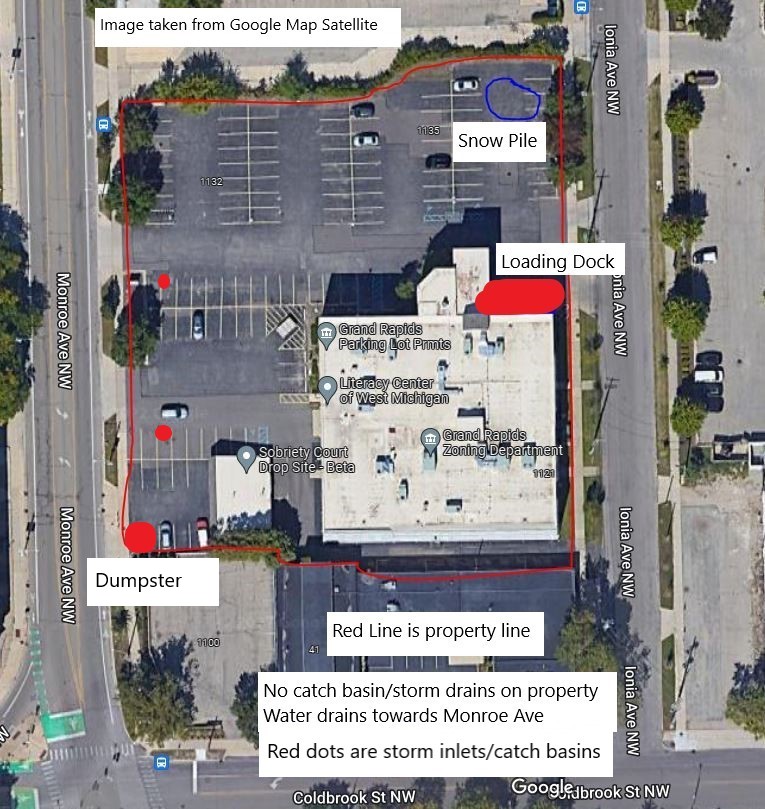
An example using Google Maps and Paint or other photo editing software.
An example using Kent County GIS Parcel Viewer and Paint or other photo editing software.
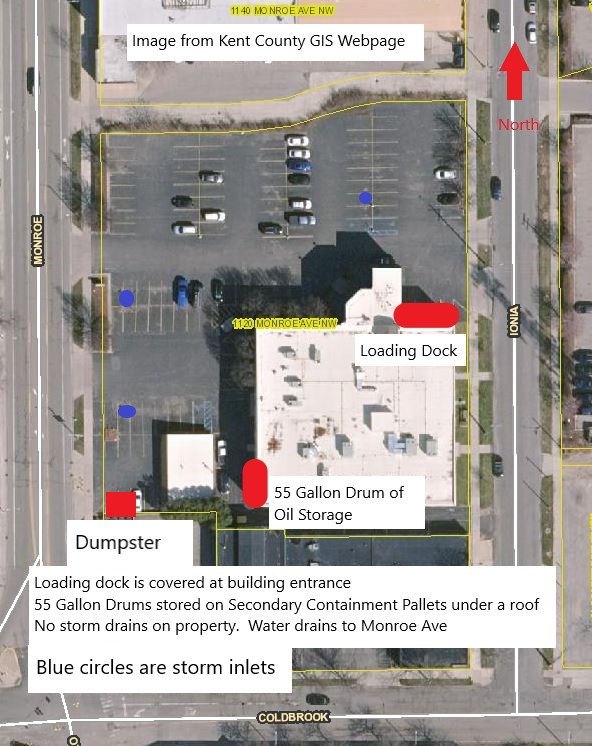
Click to go to Kent County GIS Parcel Viewer
An example from the example SWPPP from EGLE website.
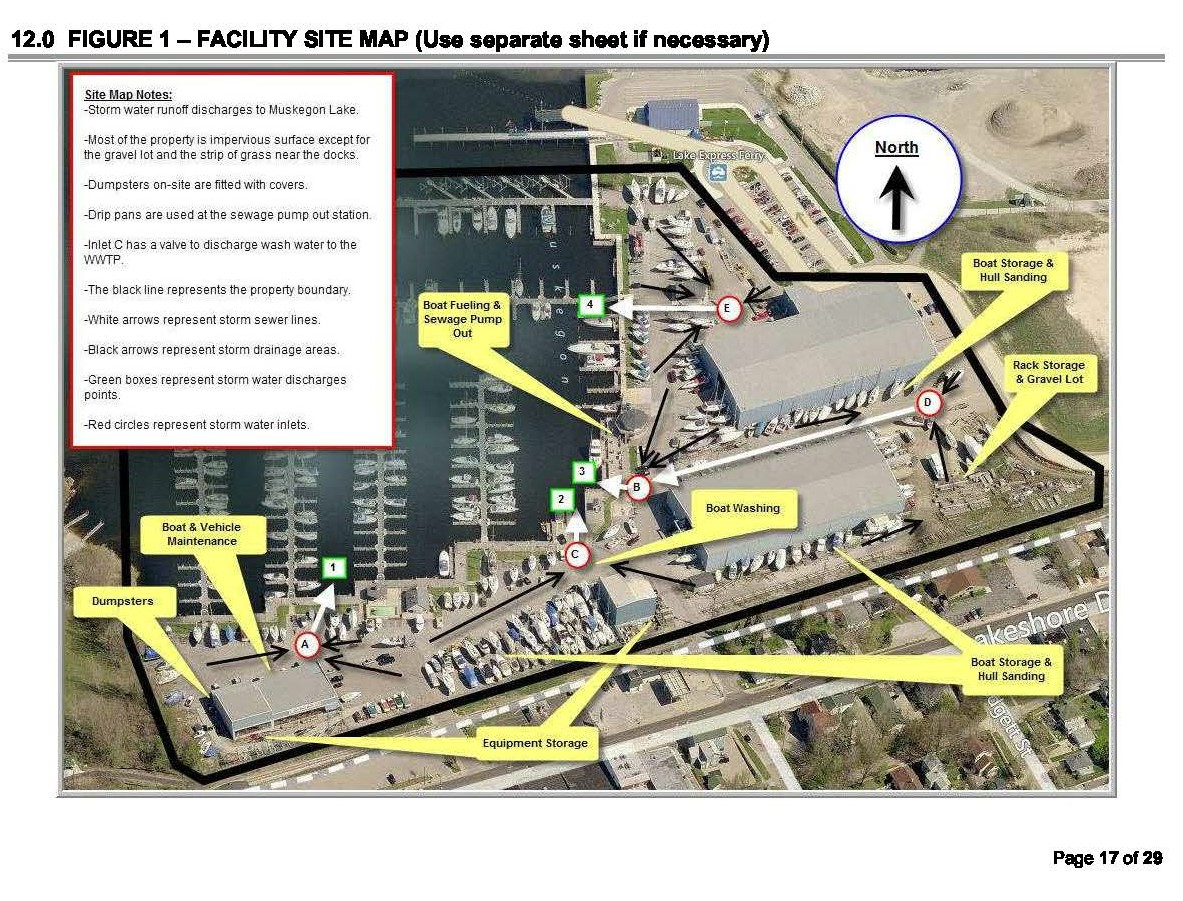
Facilities with a NPDES Permit issued by the State of Michigan must submit:
Facilities with a NEC Permit issued by the State of Michigan must submit:
The survey must be submitted online. Paper copy, faxed, emailed or other forms of submittal will not be accepted. A third party application called Citizen Access is used for submittal of the survey. An account will have to be created before you can submit the survey for the ISW Permit, if you don't already have an account. Click the button below for instructions to submit the survey for a ISW Permit.
Submit an Industrial Stormwater Survey
For a step by step guide to sign into Citizen Access, find the Industrial Stormwater Program Survey and help through the Survey, click HERE.
The Industrial Stormwater Program will have a fee associated with the permit and re-inspections. The permit fees are based on priority level and due before issuance of the permit. The fee structure is outlined below:
Low Priority: $1,370 per permit cycle
Medium Priority: $1,700 per permit cycle
High Priority: $1,900 per permit cycle
Re-Inspections: $605 per re-inspection
| High Priority | Medium Priority | Low Priority | Re-Inspection |
|
Fee per permit cycle: $1,900 |
Fee per permit cycle: $1,700 |
Fee per permit cycle: $1,370 |
Fee per inspection: $605 |
|
Permit Frequency: Annually |
Permit Frequency: every 2-years |
Permit Frequency: every 5-years |
|
|
Inspection Frequency: Annually |
Inspection Frequency: every 2-years |
Inspection Frequency: every 5-years |
Inspection Frequency: As-Needed for reportable spills and concerns with permit compliance |
All releases of any polluting material to the City Stormwater Drainage System shall be reported to the City Industrial Program Manager. Permittees shall follow instructions on issued permit.
Call (616) 456-3000 to report to the City of Grand Rapids Industrial Stormwater Water Program team.
Within ten (10) days of the release, the permittee shall submit to the GRISW a full written explanation as to the cause of the release, the discovery of the release, response (clean-up and/or recovery) measures taken, and preventive measures taken or a schedule for completion of measures to be taken to prevent re-occurrence of similar releases. This is in addition to notification requirements included in the permittee’s NPDES permit.
The permittee shall notify the GRISW, in writing, as soon as possible but no later than 10 days of knowing, or having reason to believe, that any anticipated action or activity or change has occurred or will occur including but not limited to facility expansion, production increases, or process modification, which will result in new or increased loading of pollutants to the CSDS. This notification must be reported to the GRISW by submission of an updated GRISW Survey.
City of Grand Rapids References
Any and all attachments to the permit can be found on the State of Michigan MiWaters webpage
City of Grand Rapids Program Presentations
Information on Michigan Department of Environment, Great Lakes, and Energy Industrial Storm Water Program. Information includes Industrial Storm Water Certified Operator, MiWaters, Program Training Videos, Storm Water Pollution Prevention Plans (SWPPP), and other EGLE information.
EGLE Industrial Storm Water Program
Information on General EGLE NPDES Permits
Information on EGLE No Exposure Certification (NEC)
Common Industrial Stormwater Program Terms
AST: Aboveground Storage Tank
Best management practices (BMPs): Structural devices or nonstructural practices that are designed to prevent pollutants from entering into stormwater, to direct the flow of stormwater, or to treat polluted stormwater.
Certificate of coverage (COC): A document, issued by the Michigan Department of Environment, Great Lakes and Energy, which authorizes a discharge under a general permit.
City stormwater drainage system (CSDS): Includes all wetlands, surface water bodies, and all public storm drainage structures used in connection with the collection, control, transportation, treatment, or discharge of stormwater runoff and exempted discharges within the City of Grand Rapids.
Discharge: The addition of any waste, waste effluent, wastewater, pollutant, or any combination thereof to any surface water of the state or to the CSDS.
EGLE: Michigan Department of Environment, Great Lakes and Energy
Exposure: The term exposure is used in the stormwater program to describe the potential for precipitation to come in contact with industrial materials and/or industrial activities. Generally, if a facility stores or handles anything related to industrial activity outside without a storm-resistant shelter the facility is considered to have exposure.
Industrial activities: Industrial activities include but are not limited to storage, loading and unloading, transportation or conveyance of raw, intermediate, final, or waste products.
Industrial materials: Industrial materials include but are not limited to material handling equipment (bins, boxes, pallets, racking, etc.), industrial machinery, raw materials, intermediate products, byproducts, final products, and waste products.
Inlet: A catch basin, roof drain, conduit, drain tile, retention pond riser pipe, sump pump, or other point where stormwater or wastewater enters into a closed conveyance system prior to discharge off site or into waters of the state.
ISW: City of Grand Rapids Industrial Stormwater Program
NAICS code: A NAICS (pronounced NAKES) code is a classification within the North American Industry Classification System. The NAICS is the standard used by federal statistical agencies for classifying businesses for the purpose of collecting, analyzing, and publishing data related to the U.S. economy.
NEC: Michigan’s No Exposure Certification which allows regulated facilities to forgo the need to obtain a National Pollutant Discharge Elimination System (NPDES) industrial stormwater permit if specific conditions can be met. The No Exposure Certification is applicable to all facilities regulated by industrial stormwater regulations and is the ultimate goal of the storm water program. Facilities that obtain a No Exposure Certification must maintain their condition of no exposure and are required to renew the certification every 5 years.
NOI: Notice of Intent. An NOI is a stormwater permit application.
Non-Structural control: Non-Structural Controls are Best Management Practices (BMPs) that do not involve a structured or engineered solution. They include such measures as education, site planning, and stormwater management regulations. Because it is usually easier and more effective to prevent pollution before it occurs, non-structural BMPs are very cost-effective. These measures limit or eliminate pollutants before they end up in the stormwater.
NPDES: National Pollutant Discharge Elimination System. Permit program to address water pollution by regulating point sources that discharge pollutants to waters of the United States.
Outfall: The location at which a point source discharge first enters a surface water of the state.
Point of discharge: The location of a point source discharge where stormwater is discharged directly into a separate storm sewer system.
Point source discharge: A discharge from any discernible, confined, discrete conveyance, including but not limited to any pipe, ditch, channel, tunnel, conduit, well, discrete fissure, container, or rolling stock. Changing the surface of land or establishing grading patterns on land will result in a point source discharge where the runoff from the site is ultimately discharged to waters of the state.
Polluting material: Any material, in solid or liquid form, identified as a polluting material under the Part 5 Rules, Spillage of Oil and Polluting Materials, promulgated under Part 31 of the NREPA (R 324.2001 through R 324.2009 of the Michigan Administrative Code).
GRISW Priority Levels:
Low priority: Facilities that don’t currently have outdoor activities/material storage that is impacting stormwater but they could have as part of their operations. These facilities will generally hold a NEC with the State. These facilities will be inspected every 5 years.
Medium priority: Facilities with outdoor activities/material storage that rely on structural controls to manage stormwater pollution. These facilities will be inspected biennially (every two years).
High priority: Facilities with outdoor activities/material storage that rely on nonstructural controls to manage stormwater pollution. These facilities will be inspected annually.
Secondary containment structure: A unit, other than the primary container, in which significant materials are packaged or held, which is required by state or federal law to prevent the escape of significant materials by gravity into sewers, drains, or otherwise directly or indirectly into any sewer system or to the surface waters or groundwaters of the state.
Standard industrial classification (SIC) code: Four-digit numerical codes that categorize the industries that companies belong to based on their business activities. Standard Industrial Classification codes were mostly replaced by the six-digit North American Industry Classification System (NAICS).
SIC code: Standard Industrial Classification (SIC) codes are four-digit numerical codes that categorize the industries that companies belong to based on their business activities.
Significant materials: Any material which could degrade or impair water quality, including but not limited to: raw materials; fuels; solvents, detergents, and plastic pellets; finished materials such as metallic products; hazardous substances designated under Section 101(14) of the Comprehensive Environmental Response, Compensation, and Liability Act (CERCLA) (see 40 CFR 372.65); any chemical the facility is required to report pursuant to Section 313 of Emergency Planning and Community Right-to-Know Act (EPCRA); polluting materials as identified under the Part 5 Rules (R 324.2001 through R 324.2009 of the Michigan Administrative Code); Hazardous Wastes as defined in Part 111, Hazardous Waste Management, of the NREPA; fertilizers; pesticides; and waste products such as ashes, slag, and sludge that have the potential to be released with stormwater discharges.
Stormwater: Stormwater runoff, snow melt runoff, surface runoff and drainage, and non-stormwater included under the conditions of this permit.
Structural control: These types of controls are physical features that control and prevent stormwater pollution. They can range from preventive measures to collection structures to treatment systems. Structural controls will typically require construction of a physical feature or barrier. Structural controls include but are not limited to temporary and permanent coverings, stormwater conveyances, diversion dikes, grading, paving, curbing, drip pans, secondary containment, catch basin inserts, detention and retention ponds, vegetative filters, and oil/water separators.
Stormwater Pollution Prevention Plan (SWPPP): A plan required to be developed for facilities that are subject to the NPDES Industrial Stormwater Permit. The SWPPP is a written plan that describes the control measures an industrial facility will take to reduce or eliminate pollutants in stormwater. In general, these measures include preventative maintenance, good housekeeping and material handling practices, as well as proper spill response procedures.
UST: Underground Storage Tank
Contact Us
Phone: 311 or (616) 456-3000
Email: industrialsw@grcity.us

Engage with the City

