Lien Guide
Are you a property owner? Your water and sewer bills are liens on your property. This means you’re responsible for paying the water/sewer bills. We don’t turn off water between owners, so you may be responsible for paying the former owner’s final water and sewer bill.
If your water/sewer goes unpaid for an extended amount time, it'll become a lien on your property. A lien is a notice attached to your property telling the world that a creditor claims you owe it some money. A lien is generally filed with a county records office for real property. Liens on real estate are a common way for creditors to collect bill payments.
Past Due Water/Sewer Bills Timeline
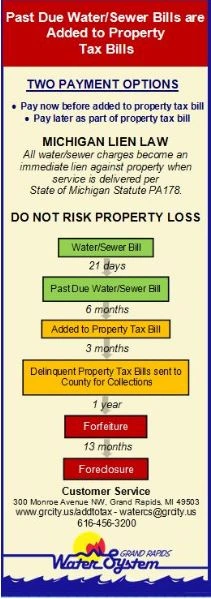
Past due water/sewer bills can lead to property loss. To avoid property loss, check out our timeline below:
Water/Sewer Liens
By state law, unpaid water/sewer services are a liens(Show info) against the property. As a result, the property owner is ultimately responsible for paying them.
Unpaid water and sewer bills are certified as a lien(Show info) in November of each year. They’re turned over to the tax collecting authority for collection in March. Once turned over to the tax authority, the unpaid water/sewer bill is now a delinquent tax. The bill amount is then added to tax rolls.
Before your unpaid water/ sewer bills are turned into lien, you'll get several past due notices. Customer service will also notify you about the bill's lien placement. Past due water/sewer bills are added to property tax bills. If the add-to-tax balance is not paid, it will be turned over to the tax authority to be placed on the property tax rolls.
Do you have a water/sewer bill that has been turned over to the tax authority and is now an unpaid property tax? Contact your tax authority immediately. Find out the status of your property. You may be able to make partial payments depending on how long you have been delinquent. Please don't wait. If you wait, you may have to pay as many as 3 years of delinquent taxes at once to keep you property.
Forfeiture
Forfeiture is the loss of property ownership. If your property is in forfeiture, you still have time to get back your property. You have 1 year before it is foreclosed.
The Delinquent Property Tax Foreclosure Public Act 123 of 1999 allows delinquent taxes to be paid in approximately 2 years. However, the interest and fees will be higher. When a property is forfeited, the interest rate goes from 1% per month to 1.5% per month. A $175 forfeiture fee is also added.
Foreclosure
Ultimately, unpaid water/sewer bills can cause foreclosure on a home.
After a property has been in forfeiture for one year and the water/sewer bills are still unpaid, it will be foreclosed. Unfortunately, once your property is foreclosed, you can't get your property back. Foreclosure is final. Property that has been foreclosed will be sold at public auction.


